
Nailing the perfect macaron shell feels like a magic trick. You mix sugar and egg whites, bake them, and hope for smooth tops and beautiful ruffled feet. But behind that magic lies strict baking science. The foundation of any successful macaron is the meringue. If you fail to beat your egg whites to the correct consistency, your batter will collapse, and your cookies will crack.
The most common question bakers ask is, “How long should I beat my meringue to get stiff peaks?”
The truth is that timing depends on several factors, including your mixer, your method, and your ingredients. In this guide, we will break down exactly how long it takes to achieve stiff peaks. You will learn the visual cues to look for, the differences between meringue methods, and how to rescue a failing batch.
From Mixing Bowl to Macaron Packaging: Why Meringue Matters
Whether you bake for a weekend hobby or plan to fill professional Macaron Packaging for a bakery business, consistency is everything. The meringue gives your macaron its structure. It traps tiny air bubbles that expand in the oven. This expansion lifts the shell and creates the signature feet.
If you under-whip your meringue, the structure remains weak. The air bubbles collapse, leaving you with flat, hollow, or cracked shells. If you over-whip, the protein structure becomes rigid and dry. Your batter will turn brittle, and the baked cookies will look rough and dull. Reaching the exact stage of stiff peaks ensures your batter flows perfectly during the folding process (macaronage).
The Three Meringue Methods and Their Timings
There are three main ways to make meringue for macarons: French, Swiss, and Italian. Each method treats the egg whites and sugar differently. Because of this, each method requires a different whipping time.
1. The French Method
The French method is the most traditional and straightforward approach. You slowly add granulated sugar to raw egg whites while whipping them.
Because the sugar dissolves directly into the cold or room-temperature egg whites, this method takes the least amount of time to reach stiff peaks. However, it is also the least stable meringue, meaning you must watch it closely to avoid over-whipping.
- Average Time (Stand Mixer): 5 to 8 minutes
- Average Time (Hand Mixer): 8 to 12 minutes
2. The Swiss Method
The Swiss method adds a layer of heat. You whisk the egg whites and sugar together over a double boiler until the sugar fully dissolves. Then, you move the warm mixture to your stand mixer and whip it until it cools and reaches stiff peaks.
The heat alters the proteins in the egg whites, making the resulting meringue much more stable than the French method. Because you start with a warm mixture, it takes longer to build the structure and cool the bowl down.
- Average Time (Stand Mixer): 8 to 12 minutes
- Average Time (Hand Mixer): 12 to 18 minutes
3. The Italian Method
The Italian method is the most advanced and highly favored by professional pastry chefs. You boil sugar and water into a hot syrup and slowly pour it into whipping egg whites.
This creates the most stable, dense, and marshmallow-like meringue. The hot syrup cooks the egg whites as they whip. Because you are adding hot liquid and need the bowl to cool completely, this method takes the longest.
- Average Time (Stand Mixer): 10 to 15 minutes
- Average Time (Hand Mixer): Not recommended (very difficult to pour boiling sugar while holding a hand mixer)
Whipping Time Reference Table
Use this quick reference guide to estimate your whipping times based on your chosen method and equipment.
| Meringue Method | Heat Application | Stand Mixer Time | Hand Mixer Time | Stability Level |
|---|---|---|---|---|
| French | None (Raw) | 5 – 8 mins | 8 – 12 mins | Low |
| Swiss | Double Boiler | 8 – 12 mins | 12 – 18 mins | Medium |
| Italian | Boiling Sugar Syrup | 10 – 15 mins | N/A | High |
Note: Times are approximate. Always rely on visual cues rather than a strict timer.
Visual Cues: How to Test for Stiff Peaks
Timers are helpful, but they cannot replace your eyes. Kitchen environments, humidity, and the age of your eggs change how fast meringue whips. You must test the meringue manually to know when it is done.
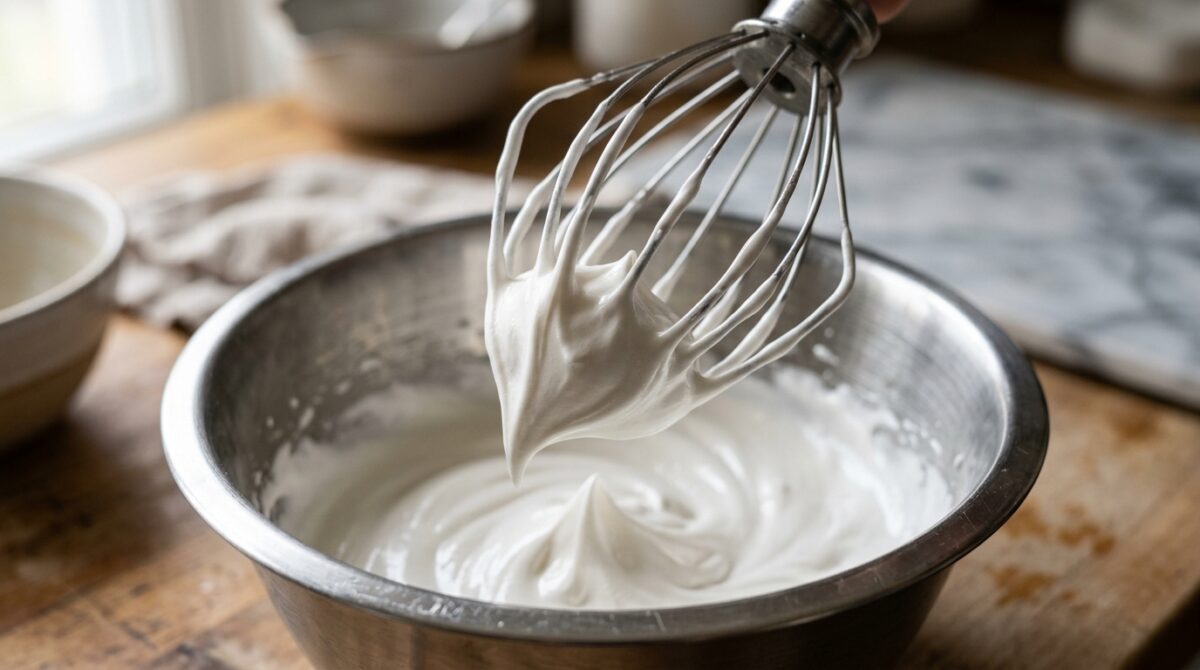
The Whisk Test
Stop your mixer. Detach the whisk attachment and scoop up a large amount of meringue from the center of the bowl. Hold the whisk upside down.
Look directly at the tip of the meringue:
- Soft Peaks: The tip immediately slumps over and melts back into itself. You need to keep whipping.
- Firm Peaks: The peak holds its shape but the very top curls over like a bird’s beak. You are very close. Whip for another 30 to 60 seconds.
- Stiff Peaks: The meringue points straight up toward the ceiling. It looks sharp, defined, and completely rigid. Even if you shake the whisk slightly, the peak does not move. Stop mixing immediately.
The Bowl Inversion Test
If you want to be completely certain, remove the mixing bowl from the stand. Slowly turn the bowl upside down over your head. If the meringue slides or shifts, it is not ready. If it stays perfectly locked in place without dropping, you have achieved stiff peaks.
Variables That Change Your Whipping Time
If your meringue takes unusually long to whip, or if it finishes much faster than expected, one of these variables is likely at play.
1. Equipment Cleanliness
Egg whites refuse to whip if they come into contact with grease or fat. Even a tiny speck of leftover butter in your bowl will ruin the batch. Always wipe down your mixing bowl and whisk with white vinegar or lemon juice before starting. Metal and glass bowls work best. Avoid plastic bowls, as they tend to hold onto unseen grease.
2. Egg White Temperature
Room-temperature egg whites whip faster and create more volume than cold egg whites straight from the fridge. Take your eggs out about an hour before you plan to bake.
3. Aging the Egg Whites
Many bakers separate their egg whites and leave them in the fridge for 24 to 48 hours before baking. This process evaporates some of the water content. Less water means the proteins bond faster, significantly reducing your whipping time and creating a tighter, more stable meringue structure.
4. Mixer Speed
Never whip your meringue on the highest speed. Blasting the egg whites on high speed creates large, unstable air bubbles that easily collapse in the oven. Start on a low speed until the egg whites become frothy. Gradually increase to a medium-high speed. A slower, steadier whip takes longer but builds tiny, uniform air bubbles that create a flawless macaron shell.
Protecting Your Hard Work
Once you pull your perfectly footed macarons out of the oven, you must store them carefully. Macarons are highly fragile and require specific care, especially if you plan to gift or sell them.
Placing them loosely in a standard container will cause the delicate shells to shatter. Instead, you need a specialized solution. Partnering with a trusted Custom Packaging Company allows you to design boxes with precise inserts. These inserts hold each cookie securely in place. Proper packaging protects the structural integrity of your baked goods, ensuring the stiff-peak texture you worked so hard to achieve makes it safely to the final destination.
Conclusion
Finding the exact time it takes to beat meringue for stiff peaks requires a blend of science and practice. While the French method takes around 5 to 8 minutes and the Italian method takes up to 15 minutes, your eyes are your best tool.
Watch for the sharp, upright point on your whisk. Keep your tools completely free of grease, whip on a medium-high speed to build stable air bubbles, and never rush the process. By mastering the visual cues of stiff peaks, you set a perfect foundation for macaronage, leading to beautiful, bakery-quality macarons every single time. Next time you bake, ditch the timer and trust the whisk test.
Frequently Asked Questions (FAQs)
Can you over-whip meringue for macarons?
Yes. Over-whipped meringue looks clumpy, dull, and dry, almost like styrofoam. When you try to fold it, it will not smooth out properly. Over-whipped batter leads to brittle, hollow macaron shells. If your meringue loses its glossy shine and starts looking grainy, you have gone too far.
Why is my meringue staying watery?
If you have been whipping for over 15 minutes and the mixture still looks like soapy water, fat or grease got into the bowl. This usually happens if a tiny drop of egg yolk mixes in with the whites, or if your bowl was not fully clean. Unfortunately, you cannot fix this. You must wash your bowl with vinegar and start over.
Should I add cream of tartar?
Cream of tartar is a mild acid that helps stabilize egg whites. It prevents the proteins from bonding too quickly, which reduces the risk of over-whipping. Adding a quarter teaspoon of cream of tartar per three egg whites is a highly recommended safety net, especially when using the French method.
Can I use carton egg whites?
Liquid egg whites from a carton are heavily pasteurized. The heat used in pasteurization damages the proteins needed to build a strong meringue. While some bakers manage to make them work, they generally take twice as long to whip and often fail to reach true stiff peaks. It is always better to use fresh eggs and separate them yourself.
How do I know if my mixer speed is right?
On a standard 10-speed stand mixer, you should do the majority of your whipping at speed 6 or 8. Speed 10 is too aggressive and will create weak air bubbles. Speed 4 is too slow and will drag the process out unnecessarily. Medium-high is the sweet spot for stability and efficiency.